
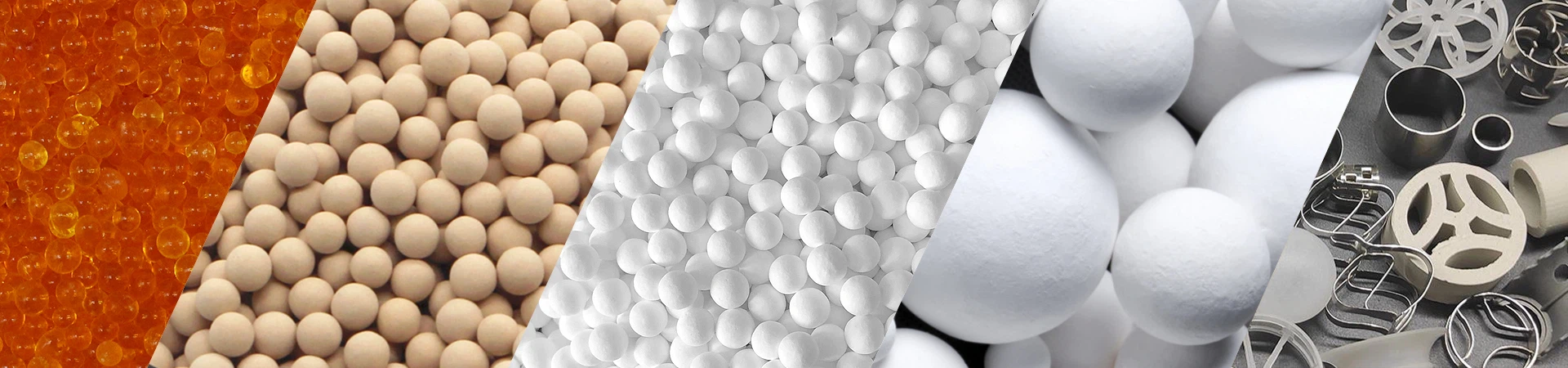
Compared with activated alumina and silica gel, molecular sieve has the following significant advantages:
1.It has strong adsorption selectivity and only adsorbs molecules with a critical diameter smaller than the pore size of the molecular sieve. In addition, it is also highly selective for polar molecules and can firmly adsorb these molecules.
2.Molecular sieves for dehydration, such as 4A molecular sieve, do not adsorb heavy hydrocarbons, thereby avoiding the adsorbent failure due to adsorption of heavy hydrocarbons.
3.It has high-efficiency adsorption performance and maintains a relatively high adsorption capacity when the relative humidity or partial pressure is very low, especially suitable for deep drying.
4.When adsorbing water, acid gas can be further removed at the same time.
5.Not susceptible to damage by liquid water.
GUANGZHOU CHEMXIN ENVIRONMENTAL MATERIAL CO.,LTD. has molecular sieve type: 3A / 4A / 5A / 13X / CMS, etc.
Most of the adsorption dehydration methods used in modern LNG plants are molecular sieve adsorption. Although molecular sieves are more expensive, they are an excellent adsorbent for dehydration. Before natural gas is liquefied or deep-frozen, it is required to reduce the dew point of natural gas to a very low value. At this time, it is more appropriate to use molecular sieves for dehydration. The main disadvantage of molecular sieves is that when chemicals such as oil droplets or alcohols are brought in, the molecular sieves will deteriorate and consume high heat during regeneration.
In actual use, molecular sieves can be used in series with silica gel or activated alumina. The natural gas to be dried first passes through the silica gel bed to remove most of the saturated water, and then passes through the molecular sieve bed to remove the remaining trace moisture to obtain a very low dew point.
More applications on Molecular Sieve, please contact us anytime.
E: sales@chemxin.com
www.chemxin-en.com