
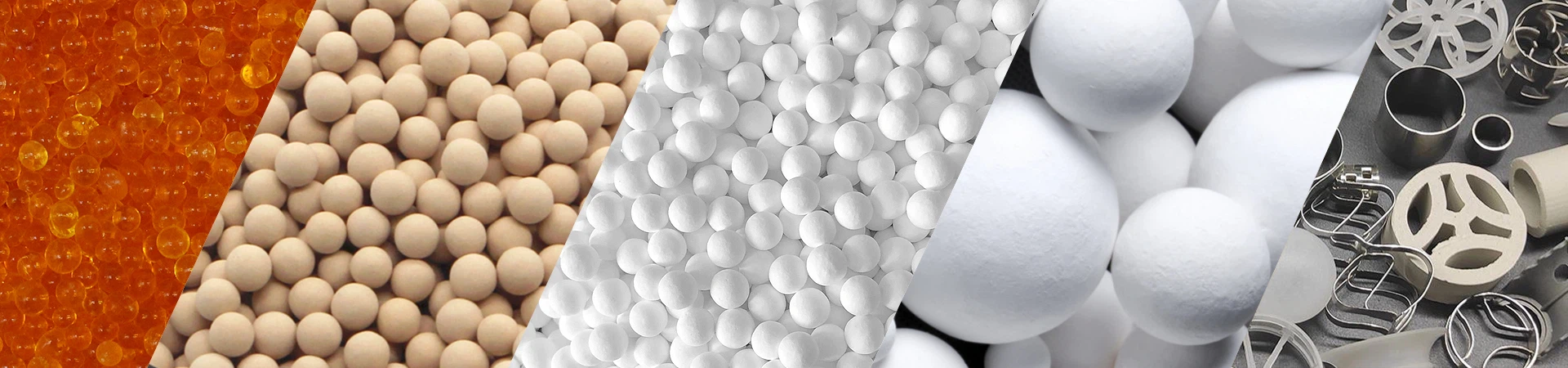
Division and Core Characteristics of the Three Adsorbents
1. Silica Alumina Gel (for the first layer of coarse desorption, on the inlet side)
Advantages: Maximum water absorption capacity at normal temperature and high humidity (25% - 30% mass water absorption rate), low regeneration temperature (150 - 180℃), lowest cost; primarily removes a large amount of free water and saturated water vapor, significantly reducing the load of the subsequent two stages.
Function: Pre-cleaning, buffer liquid impact, protection of alumina and molecular sieve.
2. Activated Alumina (middle layer, transitional buffer)
Advantages: High mechanical strength, resistance to liquid impact, oil and impurity resistance; 15% - 20% water absorption capacity; balanced adsorption performance in dry and wet conditions; regeneration temperature 180 - 240℃; capable of filtering trace oil mist, protecting molecular sieve from being damaged by heavy hydrocarbons/oil.
Function: Intermediate deep desorption, impurity interception, connecting the upper and lower stages, significantly extending the service life of molecular sieve.
3. Molecular Sieve (3A/4A/13X, top layer for fine desorption outlet side)
Advantages: Uniform micropores, strong adsorption even at extremely low water vapor pressure; can stabilize the gas dew point to -70 - -100℃, water content < 1ppm, the only adsorbent capable of achieving ultra-deep desorption.
Function: Terminal polishing, removing residual trace water vapor from alumina, meeting the requirements for deep desorption in high-purity/low-temperature processes.

CHEMXIN has engaged in Molecular Sieve since 2002, over 23 years of experience in manufacturer, development and installation guidance. Let's share more cases and study together.
Email: sales@chemxin.com
Web.: www.chemxin-en.com