
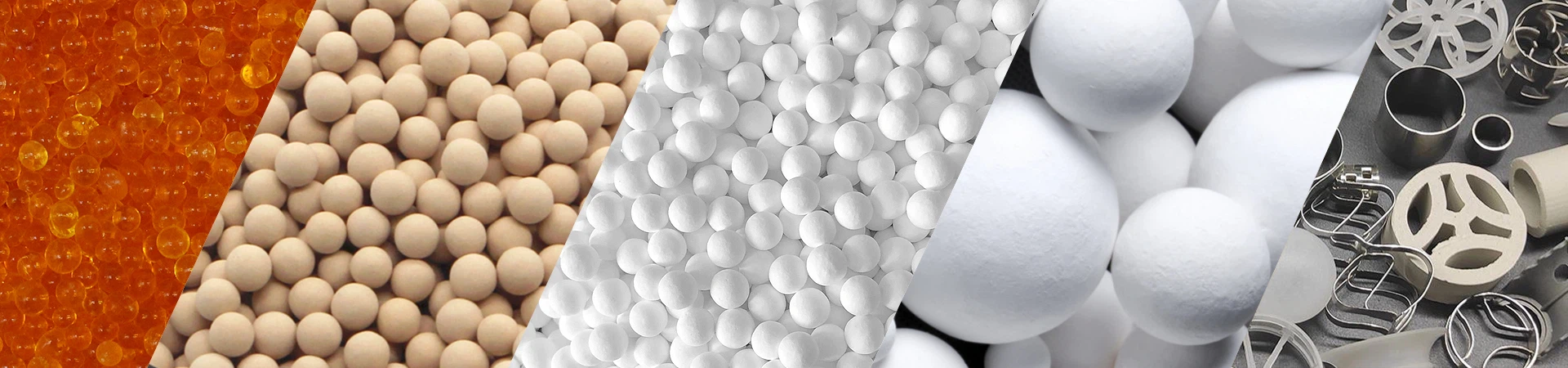
Molecular sieves are crystalline metal alumino silicates having a threedimensional interconnecting network of silica and alumina tetrahedra. Natural water of hydration is removed from this network by heating to produce uniform cavities which selectively adsorb molecules of a specific size.
A 4 to 8-mesh sieve is normally used in gasphase applications, while the 8 to 12-mesh type is common in liquidphase applications. The powder forms of the 3A, 4A, 5A and 13X sieves are suitable for specialized applications.
Type | 3A |
Composition | 0.4K2O . 0.6Na2O . Al2O3 . 2SiO2 . 4.5 H2O (SiO2 : Al2O3 ≈2) |
Description | Chemxin Molecular Sieve type 3A is an alkali metal alumina-silicate; it is the potassium form of the type A crystal structure. Type 3A has an effective pore opening of about 3 angstroms (0.3nm). This is large enough to allow in moisture, but excludes molecules such as unsaturated hydrocarbons which can potentially form polymers; and this maximizes lifetime when dehydrating such molecules. |
Major Applications | a) Drying of unsaturated hydrocarbons (e.g. ethylene, propylene, butadien) b) Cracked Gas Drying c) Drying of natural gas, if COS minimization is essential, or a minimum co-adsorption of hydrocarbons is required. d) Drying of highly polar compounds, such as methanol and ethanol e) Drying of liquid alcohol f) Static, (non-regenerative) dehydration of insulating glass units, whether air filled or gas-filled. g) Drying of CNG. |
Type | 4A |
Composition | Na2O . Al2O3 . 2SiO2 . 4.5 H2O (SiO2 : Al2O3 ≈2) |
Description | Chemxin Molecular Sieve type 4A is an alkali alumina silicate; it is the sodium form of the Type A crystal structure. 4A molecular sieve has an effective pore opening of about 4 angstroms (0.4nm). Chemxin type 4A molecular sieve will adsorb most molecules with a kinetic diameter of less than 4 angstroms and exclude those larger. Such adsorb-able molecules include simple gas molecules such as oxygen, nitrogen, carbon dioxide and straight chain hydrocarbons. Branched chain hydrocarbons and aromatics are excluded. |
Major Applications | a) Drying and removing of CO2 from natural gas, LPG, air, inert and atmospheric gases, etc. b) Removal of hydrocarbons, ammonia and methanol from gas streams (ammonia syn gas treating) c) Special types are used in the air break units of buses, trucks and locomotives. d) Packed in small bags, it may be used simply as a packaging desiccant. |
Type | 5A |
Composition | 0.7CaO . 0.3Na2O . Al2O3 . 2SiO2 . 4.5H2O (SiO2 : Al2O3 ≈2) |
Description | Chemxin Molecular Sieve type 5A is an alkali alumina silicate; it is the calcium form of the Type A crystal structure. Type 5A has an effective pore opening of 5 angstroms (0.5 nm). It will adsorb molecules with a kinetic diameter of less than 5 Angstrom and exclude those larger. It is especially suitable for PSA adsorption applications where it may be used for the separation of normal- and iso- paraffins (C4 to C6 species), in PSA hydrogen purification and in oxygen concentrators. |
Major Applications | a) The strong ionic forces of the divalent calcium ion makes it an excellent adsorbent to remove water, CO2, H2S from sour natural gas streams, while mini missing COS formation. Light mercaptans are also adsorbed. b) Separation of normal- and iso paraffin’s. c) Production of high purity N2, O2, H2 and inert gases from mixed gas streams d) Static, (non-regenerative) dehydration of insulating glass units, whether air filled or gas-filled. |
Type | 13X |
Composition | Na2O. Al2O3. (2.8±0.2) SiO2. (6~7)H2O SiO2 : Al2O3 ≈2.6-3.0 |
Description | Chemxin Molecular Sieve 13X is the sodium form of the type X crystal and has a much larger pore opening than the type A crystals. It will adsorb molecules with a kinetic diameter of less than 10 Angstrom (1.0 nm) and exclude those larger. It also has the highest theoretical capacity of the common adsorbents and very good mass transfer rates. It can remove impurities too large to fit into a type A crystal and is commonly used to separate nitrogen from oxygen. |
Major Applications | a) Removal of CO2 and moisture from air (air pre-purification) and other gases. b) Separation of enriched oxygen from air. c) Removal of n-chained compositions from aromatics. d) Removal of R-SH and H2S from hydrocarbon liquid streams (LPG, butane etc.) e) Catalyst protection, removal of oxygenates from hydrocarbons (olefin streams). f) Production of bulk oxygen in PSA units. |
