

Carbon Molecular Sieve Cms 260 For Nitrogen Generator
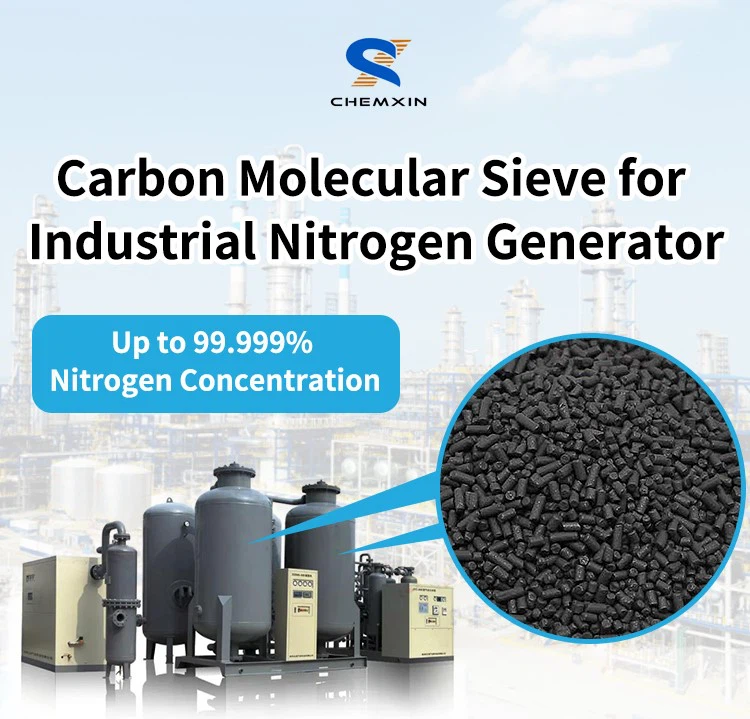
Carbon molecular sieve belongs to carbon adsorbent, which is a porous substance composed of carbon, and the pore structure model is a disordered stacked carbon structure. Carbon molecular sieves are non-stoichiometric compounds, and their important properties are based on their microporous structure. Its ability to separate air depends on the different diffusion speeds of various gases in the air in the micropores of carbon molecular sieves, or different adsorption forces, or both effects work at the same time. Under equilibrium conditions, the adsorption capacity of carbon molecular sieves to oxygen and nitrogen is quite close, but the diffusion rate of oxygen molecules through the narrow gaps of the carbon molecular sieve microporous system is much faster than that of nitrogen molecules. Carbon molecular sieve air separation nitrogen production is based on this Performance, nitrogen is separated from air by the PSA process well before a time when equilibrium conditions are reached.
In industry, carbon molecular sieve pressure swing adsorption is used to separate air to produce nitrogen, and the concentration of nitrogen produced is 95%~99.999%, which meets the concentration requirements of industrial production such as the electronics industry.

Technical Parameter:
| Model | Carbon Molecular Sieve | |||
| Appearance | Black, extruded(pellet) | |||
| Nominal pore diameter | 4 angstroms | |||
| Bulk Density |
630-680 KG/M3 |
|||
| Dust level | 100PPM Max | |||
|
Adsorbent time (S) (The test temperature≤20℃) |
2*50(can be adjusted) | |||
| Diameter (mm) | 1.0-1.2 | 1.3-1.5 | 1.5-1.8 | 1.8-2.0 |
| Crushing Strength (N/pc) | 50-60 | 60-70 | 70-80 | 110-130 |
| Production Output | Data as follows | 3-8% loss | 5-15% loss | 10-20% loss |
| Type |
Adsorption Pressure (MPa) |
N2 Purity(%) |
N2 quantity (M3/T.MT) |
Air/N2 (%) |
| CMS-260 |
0.75-0.8 |
99.999 | 75 | 6.5 |
| 99.99 | 120 | 4.6 | ||
| 99.9 | 175 | 3.4 | ||
| 99.5 | 260 | 2.9 | ||
| 99 | 320 | 2.2 | ||
| 98 | 350 | 2.1 | ||
| 97 | 390 | 2.0 | ||

What are the specific applications of carbon molecular sieves in the electronics industry?
A/ Nitrogen Production: Many processes in the electronics industry require high-purity nitrogen, and carbon molecules can be used in pressure swing adsorption nitrogen production devices. By taking advantage of the difference in adsorption capacity of carbon molecular sieves for oxygen and nitrogen in the air, oxygen and other impurities are adsorbed under pressure, allowing nitrogen to be enriched. Thus, high-purity nitrogen is produced and used as a protective gas in the production, storage and transportation of electronic components to prevent oxidation of the components.
B/ Hydrogen Purification: In the production process of some electronic materials, high-purity hydrogen is required. Carbon molecular sieves can remove impurity gases such as carbon dioxide, carbon monoxide, and water vapor from hydrogen-containing mixed gases through adsorption separation methods, thereby obtaining high-purity hydrogen and meeting the strict requirements of the electronics industry for hydrogen purity.
C/ Air Drying: The production environment of the electronics industry has strict requirements for humidity. Carbon molecules have good water absorption and can be used in air drying systems. It can absorb moisture in the air, reduce air humidity, provide a dry environment for the manufacturing of electronic components, prevent problems such as short circuits and corrosion caused by moisture, and improve product quality and reliability.
Hot Tags: carbon molecular sieve cms 260 for nitrogen generator, manufacturers, brands, low price, in stock, Pigment and solvent drying additive, 5A Purmol Powder, 4A Purmol Powder, 13x APG zeolite for moisture removal, 4a molecular sieve for argron removal, 3a molecular sieve activated powder
Send Inquiry
