


4a Molecular Sieves For Purification Of Trace Water in N-hexanol Solvent
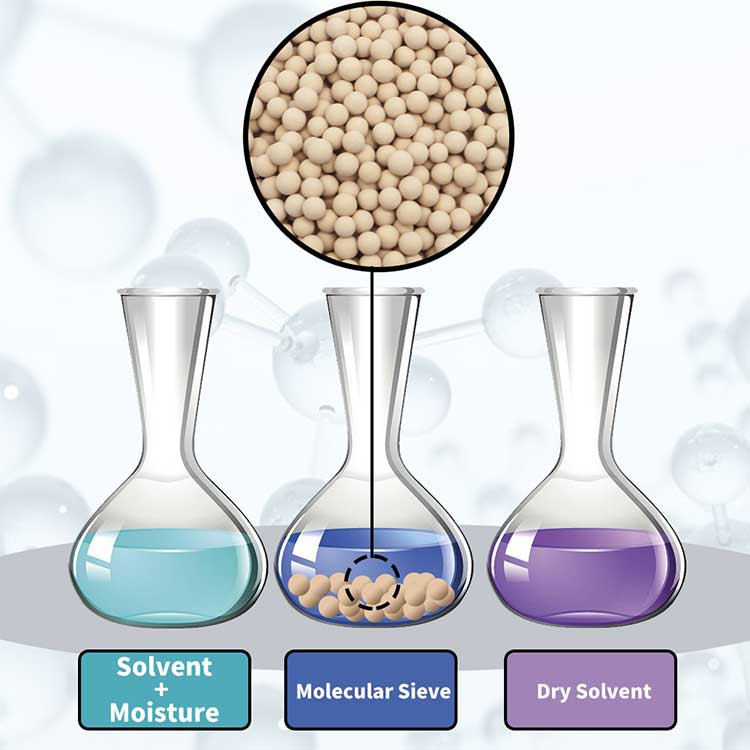
N-hexanol is a colorless and transparent liquid with a special aroma. Its molecular structure is CH3(CH2)5OH. It is used as an organic solvent and organic synthesis raw material, drug manufacturing and flavor preparation.
In order to obtain anhydrous n-hexanol, the commonly used methods are:
1. Distillation: Taking advantage of the difference between the boiling point of n-hexanol, which is about 157.88°C and the boiling point of other impurities, it is separated by a distillation tower to obtain n-hexanol with slightly higher purity.
2. Molecular sieve treatment: Using the adsorption properties of molecular sieves, trace water in n-hexanol is removed. This method can obtain anhydrous n-hexanol with extremely high purity.
Notes on the use of molecular sieves:
1. Select molecular sieves: First, you need to select a suitable molecular sieve. For removing water from n-hexanol, commonly used molecular sieve types include 3A and 4A, which have high adsorption capacity, especially for water molecules.
2. Build a system: According to experimental or production requirements, build a system including a n-hexanol storage tank, a molecular sieve adsorption column, a collection container, and necessary pipes and valves. Make sure all parts are tightly connected without leakage.
3. Filling molecular sieve: Fill the molecular sieve evenly and tightly into the adsorption column to ensure its adsorption effect.
4. n-hexanol feeding: slowly introduce n-hexanol into the adsorption column through the pipeline. During the inflow process, the flow rate should be controlled to avoid the contact time between n-hexanol and the molecular sieve being too short or too long, which will affect the adsorption effect.
5. Adsorption process: When n-hexanol passes through the adsorption column, the trace water in it will be adsorbed by the molecular sieve. According to the adsorption capacity of the molecular sieve and the water content in n-hexanol, the contact time between n-hexanol and the molecular sieve needs to be maintained for a period of time.
6. Collecting anhydrous n-hexanol: After adsorption by the molecular sieve, most of the water in the n-hexanol is removed, and anhydrous n-hexanol can be collected at this time.
Technical Parameter:
| Model | 4A | |||
| Color | Light gray | |||
| Nominal pore diameter | 4 angstroms | |||
| Shape | Sphere | Pellet | ||
| Diameter (mm) | 1.7-2.5(8*12 mesh) | 3.0-5.0(4*8 mesh) | 1.6(1/16 inch) | 3.2(1/8 inch) |
| Size ratio up to grade (%) | ≥98 | ≥98 | ≥96 | ≥96 |
| Bulk density (g/ml) | ≥0.70 | ≥0.70 | ≥0.68 | ≥0.68 |
| Wear ratio (%) | ≤0.20 | ≤0.20 | ≤0.40 | ≤0.40 |
| Crushing strength (N) | ≥35/piece | ≥85/piece | ≥30/piece | ≥70/piece |
| Static H2O adsorption (%) | ≥21.5 | ≥21.5 | ≥21.5 | ≥21.5 |
| Static methanol adsorption (‰) | ≥15 | ≥15 | ≥15 | ≥15 |
| Water content (%) | ≤1.5 | ≤1.5 | ≤1.5 | ≤1.5 |
| Typical Chemical Formula |
Na2O . Al2O3 . 2SiO2 . 4.5 H2O SiO2 : Al2O3 ≈2 |
|||
| Typical Application |
a) Drying and removing of CO2 from natural gas, LPG,air, inert and atmospheric gases, etc e) For fire escape mask g) For filter |
|||

Hot Tags: 4a molecular sieves for purification of trace water in n-hexanol solvent, manufacturers, brands, low price, in stock, 4a zeolite for refrigerant drying, 4a molecular sieve powder, Carbon molecular Sieve 99 99 N2 concentration, zeolite 4a for natural gas drying, Siliporite NK 10 AP, low drew point 4a desiccant zeolite
Send Inquiry
